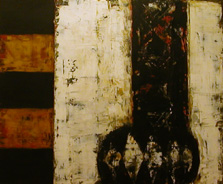
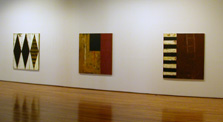
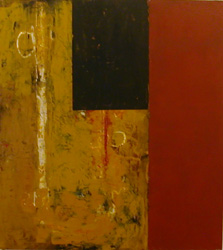
Fisher is one of those artists who brings change to his work at such a subtle pace it can only be measured after a number of years. Having said that, it is amazing how much mileage he gets while confining himself to a limited range of hues and forms. The most striking thing about these paintings is how the artist continually works the surfaces and simultaneously finds his way to a definition of color from one painting to the next. At face value the color combinations are rudimentary. But for Fisher, a red is not just red but an accumulation of several variations of the color. Look at Rust, for example, and how the red band to the right at first appears to be solid and flat. But take a closer look and notice how it glows with color and is otherwise animated by the effect. The same quality of red finds its way into the golden portion as a short uneven vertical line below the black square. But it also influences the ochre in the lower left corner as a sublimely pervasive tint.
Bill Fisher, Grindle, 2003 - 2004, oil and encaustic on wood panel, 60 x 72 in
In painting after painting Fisher asserts his content in a wide variety of ways. This is best understood in the juxtaposition of definitive architectural forms bumping up against and being
Bill Fisher, Rust, 2003 - 2004, oil and encaustic on wood panel, 60 x 54 in
defined by the intuitive nature of the paint handling. The latter contains its own subtext of meaning in that the forms created within the paint read as light and humorous even as they are moodily ethereal. From this aspect each painting dresses the stage for a variety of emotional reactions that are as conflicting as the juxta- position of the forms, color and paint handling. Comprehensively all of these qualities remain constant in Bill Fisher�s painting. Yet they are constantly in flux as applied to specific pieces and so range from the overt to the understated.
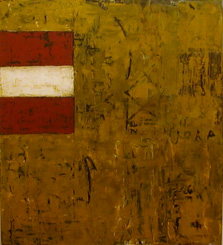
Bill Fisher, Eleven 0 Four, 2003 - 2004, oil and encaustic on wood panel, 60 x 54 in