Picture
 
Line
   

November 1st, 2006
by Joe Walentini, New York Views is published twice monthly.


In this Column...


Christina McPhee, Sara Tecchia Roma New York Gallery


Kevin Wixted, Lohin Geduld Gallery


... and some noteworthy abstraction.


Barry Goldberg, Howard Scott Gallery


Pat Lipsky, Elizabeth Harris Gallery


Phong Bui, Wooster Space Gallery

Starbucks R (Not) Us

Walter Benjamin, the Marxist pothead (for research purposes he claimed; yeah right - the same claim of many a college student) who wrote Art in the Age of Mechanical Reproduction disdained the notion of the unique object in art. I supposed this was derived from his socialist outlook; the individual as less important then the greater whole.  I won�t attempt to argue philosophy here and will concede that uniqueness, on its own, is no big deal.  For example, the second you encounter another human being you are face to face with uniqueness in that no two of us are precisely alike.

In Art Land, Duchamp, followed thereafter by many a Pop artist, made a career out of dissing unique art objects in what Jed Perl designates as anti-art.  Warhol went further with an interest in mass produced imagery even calling his work space �The Factory� (a notion that could only fascinate someone who has never actually worked in one before).  Finally, Keith Haring followed the concept to its logical end by shifting his street-hip art (for the 80�s that is) from the streets into a shop on Lafayette Street. Here was presented for sale what represented an overtly Capitalist version of the �Readymade� - logo art that easily transferred to tee shirts, coffee mugs, etc. The most profound question raised regarding art objects in Haring�s shop was �will that be cash or charge�?

Christina McPhee, Sara Tecchia Roma New York Gallery

Picture

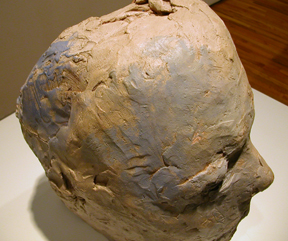
Kevin Wixted, Lohin Geduld Gallery

What I�m getting at is that Abstract art does not lend itself to crass marketing. For example, I don�t recall seeing Jackson Pollock�s drips on anyone�s tee shirt (or any other abstract images for that matter).  Ubiquitous most abstract images are not, but unique most are and with a few exceptions they resist commercial marketing.

The world has rapidly become more and more standardized; simplified ad-nauseum to brand recognition where mediocrity is too often the denominator for choice. We artists, makers of the unique handmade object, represent an ever diminishing population of authentic individualists.  Not for us mass produced goods.  Not for us standardized products.  And (typically) not for us a lot of material reward for what we do.

Next Page
Line

All Images are Copyright  2005-2006 of  the individual artists / text Copyright 2005 - 2006, Abstract Art Online. All rights reserved.

Abartonline Homepage Previous columns and other archived content. Related external websites. Submitted essays. General information about Abstract Art Online.