|
|
|
|
|
|
|
|
Hans Hoffman at Ameringer-Yohe Fine Art,
20 west 57th Street to March 15 |
|
|
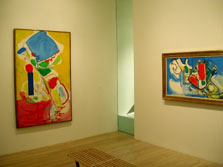
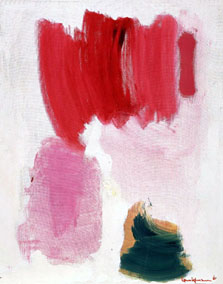
This exhibition provides an interesting mini-retrospective of Hoffman�s work ranging from around the mid 40s to just before his death in the mid 60s. The paintings are drawn from two sources: the artist�s estate and the University of California, Berkeley, Art Museum. In a matter of moments you are able to walk through two decades of history and witness the artist�s progression. It begins with a flavor of abstraction that has roots in figuration. These paintings from the 40s somewhat recall Picasso�s imagery but also suggest Pollock and Rothko prior to the development of their respective seminal styles. In this work you see a prelude of Hoffman�s own signature style; the flat-colored rectangles set in bright hues of color that shortly followed thereafter. |
|
|
|
|
|
Hans Hofmann, Moloch I, 1946, oil on canvas, 28 x 57-3/4 in |
|
|
|
The next portion of work is made up of his classic large canvases featuring brightly hued backgrounds and rectangles (most of this work is from the Berkley Art Museum). Think �Hans Hoffman� and most likely these are the paintings that first come to mind. Compared to the preceding work, the paint here becomes thicker and the color more enveloping and vivid. White, which plays a significant supporting role in the earlier paintings, almost disappears. The rectangles, with their sharply defined edges and flat color appear to �float� off the picture plane. The ground, by contrast, is more organic and loosely handled; edges and color are permitted to bleed into each other. It is this very relationship between a loosely defined grid (as exemplified by the rectangles) and the impulsive handling of other forms embedded within the ground that informs the content for this body of work. |
|
|
|
|