 |
|
|
|
|
|
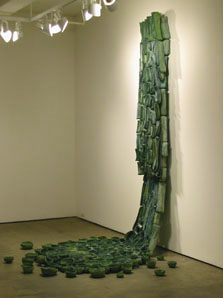
Now, given its size Squeeze is also an environ- mental piece; again as a twofold proposition. The form itself extends just beyond human proportions so that the viewer is forced to engage it from several angles but without seeing it from above. It dominates the space it inhabits as well as the space that surrounds it. There is also that roughly triangular opening at the bottom that extends upward into a rough and open seam. The break opens the form to reveal its hollowness. This also creates a whole other quality of defined space; yet another environment only now surrounded and defined by the form. In effect, Sham has turned the notion of environment inside-out with this dual aspect of space. The other thing about this piece is that the rings of wood lying flat on the floor provide it with an installation quality that extends the range of the central form. Adding to this is the small pathway leading directly to the opening established where the rings are absent. |
|
|
Wave represents another interesting juxtaposition of form and space. Seen from one angle (View 1) the form, as created by the construction of slatted wood, projects solid density. But a walk around to the other side (View 2) reveals that the piece is suddenly transformed into a lyrical, animated, even |
|
|
|
|
Foon Sham, Wave, 2004, poplar, 76 x 48 x 60 in (View 1) |
|
|
|
Previous Page |
|
|
|
|
|
|
|
|
|
|
|
 |
|
|
Foon Sham, Squeeze, 2004, oak, maple, mulberry, cherry, 8.9 x 10 x 8 in |
|
|
|
delicate, form. The transformation seems magical with how quickly it takes place. Which is the correct view? �Both� it would seem, along with any |
|
|
|
|
|
|
Foon Sham, Wave, 2004, poplar, 76 x 48 x 60 in (View 2) |
|
|
|
Next Page |
|
|





