|
|
|
|
|
|
|
Pat Lipsky at Elizabeth Harris Gallery, 529
West 20th Street to April 12th |
|
|
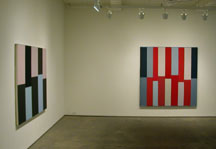
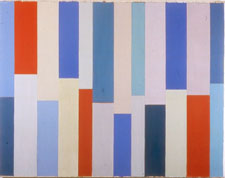
This is the third exhibition of Pat Lipsky�s that has been reviewed on these pages (her work was also profiled in our November 1999 issue). So what has changed in the work since that last show? More than anything is the shift to a more reductive esthetic compared with earlier work. The change is subtle and is found in both the forms and color. |
|
|
|
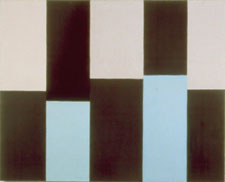
Lipsky�s signature long vertical forms are still present but their widths are more balanced in relation to each other. This is particularly true of the relationship between the forms above and below each other. Look at a painting like That�s That and you see that the major difference in the forms is where the short horizontal lines divide them. Also, the proportions are otherwise much more evenly balanced. Although not so explicitly evident in other paintings, it is nevertheless a universal change to the work overall. Compare this approach to earlier pieces where a wide variety of size and proportion of shapes were included, some of which were trapped within the picture plane and did not touch the edge. |
|
|
|
 |
|
Pat Lipsky, That�s That, 2002, oil on canvas, 53.75 x 67.5 in |
|
|
|
Something else that has nearly disappeared is the presence of lines between the forms. A close look indicates that they are still subtly present. Where they were once integral to the paintings, they now play a more subservient role. To an extent this has allowed the Figure and ground to become more distinguishable in the new work. With a painting like Black Covert for example, the pastel color forms seem to float on a ground of black. Yet, the |
|
|
|
|