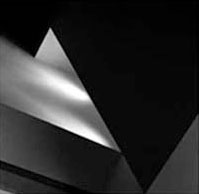
something just beyond our knowing; like parts of dream recalled in daylight. This also plays into and supports the concept of using the camera to sculpt light and shadow. Mehlman deconstructs architectural space and simultaneously rebuilds it in her own image. So, its not that the photographs would be worse for using color but more that the black and white quality offers something uniquely special in and of itself.
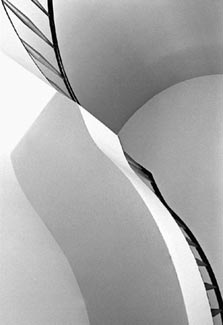
Something else this work expresses is a sense of visual rhythm. In some pieces this is innately driven by the architectural space captured. But the artist masterfully enhances this quality enough to take ownership of it. One of the best examples is found in a piece like �Sudden Lightness�. Here planes of light and shadow long with portions of an exposed railing seem to almost gyrate and dance with each other while presenting the tactile quality of soft of skin. You are cognizant of this in the imagery even as you are also aware that the materials the picture portrays are actually the opposite. The magic is in how the contradiction is resolved. The light and shadow possess a
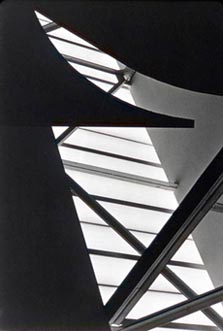
Janice Mehlman, No Crossing, 2002, silver print, 30 x 24 in
Janice Mehlman, Sudden Lightness, 2001, silver print, 30 x 24 in
stronger sense of reality over mere architectural space and so release the visual dynamics of the forms. Look at a piece like �No Crossing� where shapes containing the ephemeral characteristics of light and shadow more than hold their own against the tangible elements.